


Most advisors begin their careers asking how to build a successful practice. More clients. More revenue. More recognition. Eventually, the best leaders begin asking a different question: What am I leaving behind?
That question has very little to do with retirement. It has everything to do with stewardship.
Ownership says, “I built this.” Stewardship asks, “Will it remain valuable after I am no longer the person building it every day?” That is a much harder standard. It requires leaders to stop thinking only about what the business can produce for them and start thinking about what the business can preserve for others.
A few years ago, one of our younger kids sent a message into the family group text asking for advice about a difficult decision. Jennifer and I had not yet responded when two of the older kids jumped in. They asked good questions, offered perspective, and gave advice that sounded suspiciously familiar. Not because they were repeating some formal family mission statement—we never laminated one and hung it in the kitchen—but because they had absorbed how our family tried to approach decisions.
Jennifer and I watched the conversation unfold without needing to direct it. That was the gratifying part. The lesson had moved beyond us. It was no longer something we had to personally deliver every time. It had become part of the family.
That is what stewardship looks like inside a business.
Many advisory firms achieve impressive growth without building anything that can truly endure. Revenue climbs, but leadership remains short-term. Culture lives primarily through the founder’s personality. Client confidence depends on one individual. Promising team members are kept close enough to help but never given enough authority to grow. Eventually, they leave for a firm where leadership is an opportunity rather than a spectator sport.
Conventional wisdom says the founder deserves to remain at the center. After all, the founder took the risk, attracted the clients, and created the success. All true. But staying indispensable forever is not the highest form of leadership. It is often evidence that leadership was never fully transferred.
The rise of AI makes this distinction clearer. Technology can capture meeting notes, document workflows, preserve institutional knowledge, and automate routine communication. That is useful, especially for firms where the operating manual has traditionally been “ask the founder and hope he remembers.” But AI cannot decide what deserves to be carried forward. It cannot mentor a future leader, protect a culture, or teach a team how to make sound decisions when the answer is not sitting inside a procedure manual.
That work still belongs to leadership.
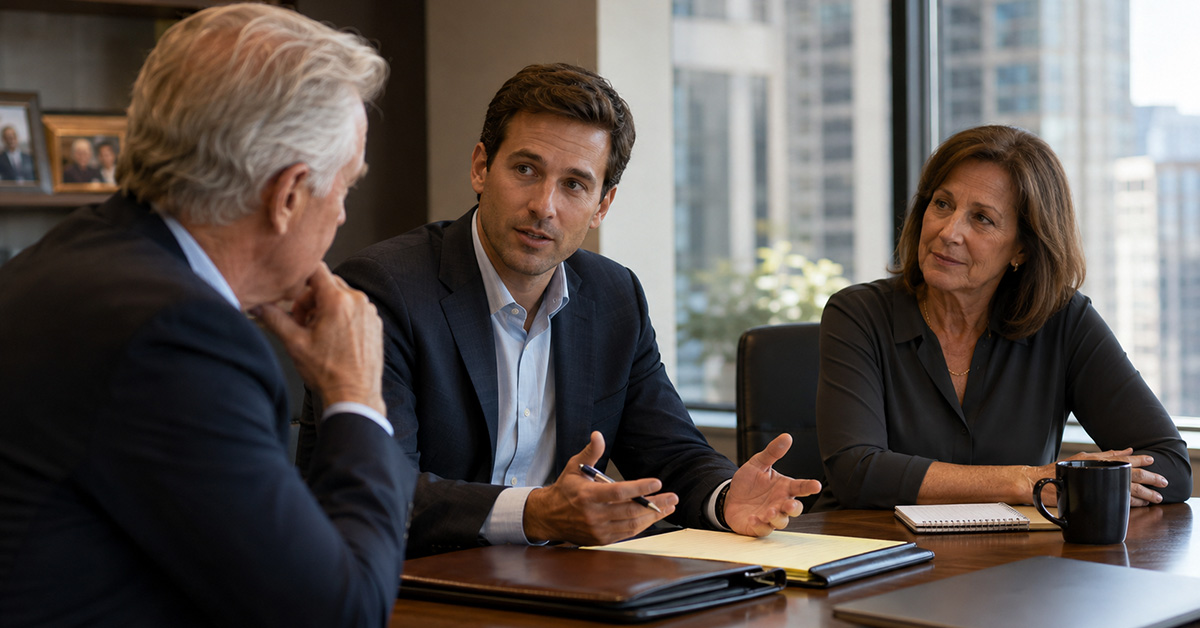
The better approach is to build continuity while you are still actively running the firm. Give future leaders meaningful responsibility before the need becomes urgent. Let them make decisions within clear boundaries and learn from the outcomes. Define the culture so it can be reinforced by more than personality. Build client relationships around a team and a process, not a single rainmaker. Treat leadership development as a core business investment, not something to address after your best people receive offers elsewhere.
For advisors who want to scale, stewardship creates practical value. It improves retention, strengthens culture, deepens leadership capacity, and makes client trust more transferable. It also creates a business that buyers, partners, employees, and clients can believe will endure.
The highest expression of leadership is not building something that needs you forever. It is building something that continues to reflect your values after it no longer depends on your daily presence.
A firm where client trust runs through a team instead of one rainmaker retains relationships better. A firm where culture lives in shared processes instead of founder personality scales without diluting what made it work. And a founder who’s built real leadership depth earns the breathing room for the strategic work only they can do.
Financial Gravity’s advisor-empowering platform exists to help firms build that infrastructure—the kind of stewardship that shows up in valuation long before it shows up in a succession document.
Stop building a firm that needs you in every room and start building one that carries your standards without you. With Financial Gravity’s Turnkey Multi-Family Office Charter, advisors get the structure to hand leadership down rather than hold it — coordinated tax, estate, planning, and investment expertise delivered by a team, so client confidence attaches to the firm instead of a single name on the door. Because the culture lives in the process rather than in one personality, our platform gives firms a way to develop the next generation of leaders while the founder is still there to teach them, which is what turns a practice into something a buyer, a partner, and a client can all believe will outlast its founder.